- How does a swimming pool work?(Moves to another section on the page)
- Cleaning the pool(Moves to another section on the page)
- Washing the pool(Moves to another section on the page)
- Chemical maintenance(Moves to another section on the page)
- Sand filter system(Moves to another section on the page)
- Chlorination of pool water(Moves to another section on the page)
- Cloudy water(Moves to another section on the page)
- Green water(Moves to another section on the page)
- Pool winterization(Moves to another section on the page)
- In what order are the chemicals added?(Moves to another section on the page)
Swimming pool maintenance is just like cleaning your home
Pool maintenance follows much the same principle as cleaning your home. If you pull the vacuum out of the closet regularly and wipe coffee stains off the kitchen counters, the effort is far smaller than having to scrub the whole place from top to bottom once things have gotten out of hand. A little regular maintenance saves you from major trouble, headaches, and extra costs. Prevention is always easier than the cure.
This guide refers to the dosing instructions for chemicals sold by Pool4You. If you purchase your chemicals elsewhere, the dosage instructions do not apply to them. Always read the dosage, usage, and safety instructions on the package.
Please note that different pool models may have their own specific features. Always follow the user manual for your specific pool.

How does a swimming pool work?
A swimming pool is very simple in terms of its operating principle, and everything is ultimately aimed at just one thing: ensuring the pool water remains clean and pleasant. Two different maintenance methods are required:
Cleaning the pool:
Remove debris with a net, vacuum the floor and clean the walls and the waterline. Sand filtration ensures that the water stays crystal clear.
Use of chemicals:
Adjust the pH to the correct level and disinfect the pool with chlorine. If necessary, use algaecide and water clarifying chemicals.
These maintenance methods support one another, and one cannot function without the other. Both are necessary to keep the pool water clean.

Why does the water in the pool get dirty?
The sources of contamination can be broadly divided into two categories:
Pool users.Perhaps the biggest source of pool water contamination is the very reason the pool was purchased in the first place – people themselves. Swimmers release things like body oils, hair and dirt into the water. Taking a shower before entering the pool is a very good idea! Various types of microorganisms can also grow in stagnant water in the pool, causing algae blooms if the pool is not properly maintained.
Environment. Wind carries dust, leaves and other debris into outdoor pools. Besides the fact that debris isn’t exactly a decorative addition to your pool, it also contaminates the water and promotes algae growth. The warmer it is, the more attention you must pay to disinfection.

Cleaning the pool – it’s not that hard
In addition to maintaining water quality, cleaning has a significant impact on swimming comfort. Crystal clear water certainly provides a completely different kind of pleasure than water decorated with leaves and pine needles. Unfortunately, debris inevitably enters the pool, as outdoor structures are exposed to debris brought by the wind and the environment.
A high-quality pool cover or enclosure reduces the amount of debris entering the pool but does not completely prevent it. A completely unprotected pool collects leaves and needles brought by the wind and every now and then a bug strays into the pool too. The sand filter handles some of these, but the rest is left to be cleaned by hand. Regular cleaning with good tools is a quick and easy procedure.

Sand filter system
The sand filter system, which consists of a pump and a filter tank, is the most important single factor in cleaning pool water. The pump sucks water from the pool through the skimmer into the filter tank, which is filled with quartz sand. Solid dirt remains in the sand and the cleaned water returns to the pool through the inlet (or multiple inlets).
Quartz sand is rinsed clean with backwashing. For outdoor pools, rinsing is done twice a month and also as needed, for example after using aluminum sulfate. Backwashing should be performed for 3–5 minutes.
The skimmer basket and the pump’s pre-filter assist the sand filter by removing the largest debris before it reaches the filter. Both must be emptied of debris regularly. The sand in the sand filter is replaced approximately every 4–5 years or when the filter pressure does not drop below 1 bar despite backwashing.

Pump operating time
“Should the pump run all the time?” No, it doesn’t need to.
The pool water should circulate through the filter at least 1.5 times per day. Of course, there is an exception to every rule, including this one, but under normal conditions, this works well.
Calculating the operating time is easy when you know two things: the pump’s capacity (how many cubic meters of water it circulates per hour) and the pool’s water volume in cubic meters.
Use the formula:
Pool water volume in cubic meters / pump capacity x 1.5 = number of operating hours
Example: If the pump capacity is 7 m³/h and the pool’s water volume is 25 m³, the calculation is 25 / 7 × 1,5 = 5,3 hours. In practice, the pump can be kept on for about 5.5 hours a day.
When the pool has been used more than usual, it is advisable to extend the filtration time. In these cases, the pump can run for the recommended duration twice a day, in the example mentioned above, the operating time would then be 10–11 hours.

Washing the pool
The filter alone is not enough to keep the water clean. To help its job, traditional cleaning is also needed. Three tools are sufficient for normal cleaning:
A net for removing debris from the water surface. It doesn’t matter whether you choose a flat net or a bag-style net, it is a matter of preference. Both will get the debris out.
A brush to remove stuck-on dirt from the pool walls or floor. A corner brush allows you to easily clean the seams.
A robotic cleaner makes pool cleaning almost fully automatic. It handles the job independently without any effort. Battery-operated vacuums offer an easy-to-use solution for quick and efficient cleaning. Traditional models based on the filter’s suction are still exist, but more and more people choose modern alternatives for the sake of convenience and efficiency.
All maintenance tools can be connected to the same telescopic pole, which are available in different lengths.
Floating debris from the water surface should be remove daily. Other cleaning can be done as needed.
If a dirty edge forms on the pool’s waterline, it can be cleaned with Gel-A and Gel-D detergents and a scrubbing sponge. The same products can also be used to clean an empty pool.

Chemical maintenance
In simple terms, chemical pool maintenance means keeping the pool water hygienic and clear by adding water treatment products designed for this purpose. At a minimum, two different substances are needed: a pH regulator and chlorine. Other chemicals, such as Algaecide and Aluminum Sulfate, are used as needed.
Dosage instructions must always be followed. The mindset of “I’ll add a bit more than recommended, just to be safe” does not work preventatively, it is likely to cause more problems. Correct dosing is also important for the safety of the pool users.
Pool water values (pH and chlorine) cannot be detected by the senses; they must always be measured before dosing chemicals using an analog or digital tester designed for that purpose.

Adjusting the pH level
We are often asked what the most important thing is in pool water care.
The answer is clear: the correct pH value of the water. It is the foundation of everything.
But why is the water pH so important?
Pool chemicals, such as chlorine, function correctly only when the water pH is within the recommended limits (7.2–7.4). A pH that is too high or too low causes problems:
- A pH value that is too high may cause the water to become cloudy.
- A pH value that is too low causes corrosion of stainless steel pool ladders, for example.
A pH level that is too high or too low may cause skin irritation and stinging eyes. The warranty for pool equipment is only valid when the pool water pH value is within the recommended limits. The correct water pH value is the foundation of pool water care – without it, no other chemical treatment works properly.

The correct pH level is therefore essential for pool chemicals to work properly, for a pleasant swimming experience and for the durability of the pool equipment. The pH value of the pool water must be between 7.2 – 7.4.
The pH value is adjusted using pH+ and pH- chemicals. pH+ raises the value, while pH- lowers it. First, measure the water’s pH value with an analog (Pooltester) or digital (Scuba 3s) meter. The same meters are also used for measuring the chlorine level.
If the pH value is below 7.2, add pH+. If the pH value is over 7.4, add pH-. Check the dosage on the packaging.
Dissolve the chemical in a bucket of water, pour the solution evenly into the pool, and turn on the filtration so that the water mixes properly.
Take a new measurement after about three hours. If the value is not correct, make a new adjustment gradually to avoid a vicious cycle where the value is alternately raised and lowered too much.
Dosage example:
If the pool size is 25 m³ and the measured pH value is 7.0, the correct chemical is pH+. 8 g of the chemical per 1 m³ raises the pH value by 0.1. Since the value is 0.2 below the recommended level, (25 × 8) × 2 = 400 g of the chemical is needed. This is an example – always check the dosage instructions on the packaging.
Measuring and correcting the pH value is a regular procedure. Rain lowers the pH value, as does the use of aluminum sulfate. Adding water to the pool can also change the value, as the added water may not be at the same pH level as the water in the pool.
We are often asked which one is usually added, pH+ or pH-. Finnish water is generally slightly on the acidic side, so the use of pH+ is more common, but that does not mean it is suitable for your specific pool water. You must not add pH chemicals based on a gut feeling. Instead, the value must always be measured to see which direction it might be off, and then the correct chemical must be used in the exact right amount.

Chlorination of pool water
Filtering the water removes solid dirt and debris but does not disinfect it. Chlorine is added to the water for disinfection. Chlorine has been used in swimming pools for ages, and it remains the best, most affordable, and most effective way to keep pool water clean.
Many prejudices and misconceptions about chlorine, such as “chlorine smells terrible” and the related classic “I don’t measure any values, I just throw it in the pool until it smells like chlorine” are also fundamentally wrong. A correctly chlorinated pool does not smell and is pleasant to use in every way.
Chlorine evaporates from the pool over time. It can evaporate quite quickly, especially from very warm water. Because of this, chlorine levels must be monitored by measuring at least once a week. In warm weather, it is important to measure chlorine levels more frequently and and add chlorine if needed.
Did you remember to adjust the pH level before adding chlorine?

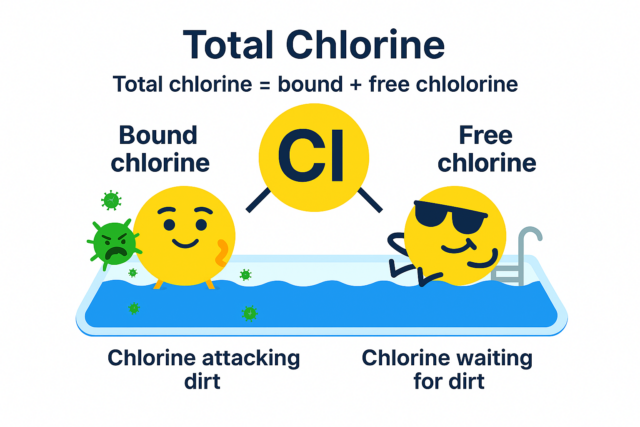
What is total chlorine, combined chlorine and free chlorine?
Total chlorine indicates the total amount of chlorine in the water. This includes both combined and free chlorine.
Part of the chlorine starts working immediately and binds to dirt and impurities. Part of the chlorine remains free, meaning it stays waiting for future impurities.
If there is a lot of dirt in the pool, all the chlorine may become bound, leaving no free chlorine at all. In this case, chlorine must be added until free chlorine remains.
When measuring chlorine, you measure free chlorine (0.4–1 mg/l). The correct level means that the pool is able to react to incoming impurities.
Chlorine requires the correct pH value (7.2–7.4) to function. The value is adjusted using pH+ (pH Plus) and pH- (pH Minus) chemicals.
Shock chlorination (super chlorination)
Shock chlorination means that the chlorine level of the pool water is raised quickly by adding granular chlorine (R-Chlorine). The dose is approximately 50–80 grams of chlorine for every 10 m³ of water. This treatment disinfects the pool and leaves the necessary amount of free chlorine in the water.
Granular chlorine is first mixed with water, for example in a bucket. Always add the water to the bucket before the chlorine. Once the solution is ready, pour it into the pool. Never throw chlorine granules directly into the pool, as they can leave marks on the pool floor.
Shock chlorination is recommended when:
- the pool is filled with water for the first time or when it is put back into use after the winter.
- the pool has had more swimmers than usual (“family use vs. a lively pool party”).
- the pool water has turned cloudy or algae starts to form.
- the algae control treatment has been done.
- the weather is extremely hot and chlorine evaporates quickly from the pool.
- the water needs extra disinfection.
Since shock chlorination temporarily raises the chlorine level to a high point, do not add other chlorine, such as C-Chlorine tablets (weekly chlorine), until the chlorine level has returned to a normal level, i.e., below 1.0 mg/l.
How soon is possible to swim after shock chlorination?
Shock chlorination may momentarily raise the water’s chlorine concentration above 3 ppm, it is advisable to wait for the chlorine level to drop below this value before swimming to avoid skin and eye irritation.
Normal chlorination of the swimming pool
Maintaining the chlorine level is not a “fix it once and forget it” task, the chlorine level must be maintained continuously. Granular R-chlorine is also suitable for continuous chlorination according to the dosage instructions, but a much easier way is to use a slow-dissolving C-Chlorine tablet, also known as weekly chlorine.
Weekly chlorine is a multi-action tablet that contains chlorine, algaecide, and clarifier. A C-Chlorine tablet or several if needed should always be placed in a floating dispenser, designed for this purpose. The tablet must never be thrown directly into the pool. It is also not recommended to place the tablet in the skimmer basket, as the chlorine will quickly make the plastic basket brittle.
The recommended dosage is one C-Chlorine tablet per 30–35 m³ of pool water every 3–5 days. The dissolution and evaporation of chlorine from the water depends on conditions such as temperature. The dosage is correct when there is always an undissolved C-Chlorine tablet left in the dispenser. Using C-chlorine does not eliminate the need to measure the chlorine levels in the pool water regularly. Measuring and adjusting the dosage if necessary is important regardless of which chlorine is used.

Green swimming pool water and algae formation
The sun and a swimming pool are a perfect combination, but at the same time sunlight creates ideal growing conditions for algae. Light provides energy for algae and water provides the environment for it to grow and multiply. The formation of algae can be prevented and it can be eliminated if it occurs.
The first sign of starting algae formation is often a slippery layer on the pool walls and floor. The next stage can be the water turning green. Sometimes the water begins to turn green even before the slipperiness.
The C-Chlorine mentioned in the previous section contains an algaecide that prevents algae formation quite well under normal conditions. However, it is not always enough, especially during heatwaves. Prevention can be enhanced by regularly adding Algaecide to the pool according to the prevention dosage instructions on the package. Using Algaecide for prevention is essential if you only use granular chlorine for chlorinating the pool, as granular chlorine does not contain algae-preventing ingredients.

What to do if the pool water turns green?
Green water means that algae has taken over the pool. The situation is fixable but requires work. It is worth remembering that chlorine alone is not enough to combat algae, as it can adapt to the effects of chlorine. Therefore, the pool's chlorine and pH balance must be maintained. Well-maintained water prevents algae growth. If algae still appears, the cause may be the conditions, not necessarily poor maintenance.
Brush the pool surfaces
Brush the pool walls and floor clean. Pay attention to joints and seams, such as the edges of the skimmer and any lights, as well as the stairs. Remove loosened debris with a net or a vacuum.
Do shock chlorination
Add granular chlorine according to the instructions and perform a shock chlorination.
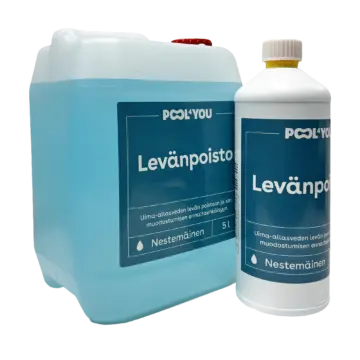
Add Algaecide
Add Algaecide to the pool according to the dosing instructions on the package.
Keep filtering on
Continue filtration until the green color disappears. Repeat the shock chlorination every 24 hours if necessary. Although there is no specific time limit for swimming after algaecide treatment, it is a good to avoid going into the pool for a while.
Cloudy pool water
Pool water should be clear, but sometimes it can look gray or milky cloudy. Cloudiness can be caused by incorrect chlorine or pH levels, so always check these first. If the levels are correct, the cause is likely very small dirt particles in the water.
A sand filter removes solid dirt, but sometimes the particles are so small that they pass through the filter and back into the pool. The solution is to combine the small particles into larger ones using a flocculant (flocking agent). For private pools, the easiest option is Aluminum Sulfate.

This is how you remove cloudiness
When levels are correct, cloudiness is often caused by fine particles. Aluminum Sulfate helps with this by combining particles into larger ones, allowing them to be trapped in the sand filter.
Add Aluminum Sulfate
Dosage of aluminum sulfate is 10 g / m³ of water. For example, a 30 m³ pool requires about 300 g.
Dissolve Aluminum Sulfate in water
Dissolve Aluminum Sulfate in water in a bucket and pour the solution into the pool.
Keep the pump on.
Keep the filter pump on until the water is clear. Clearing can take up to 24 hours depending on how cloudy the water is.
Perform a backwash
When the treatment is complete, perform a backwash for about 2 minutes, followed by a 30–60 second rinse.
Measure the pH level of the pool water
Measure the pH level of the water and correct it if necessary, as Aluminum Sulfate lowers the pH.
Winterizing the swimming pool
After summer, when the weather cools down, the swimming pool must be put into winter storage. By putting in a little effort in the autumn, pool winterization will be successful and restarting it in the spring will be easy. Note: these instructions apply to pools that are not disassembled for the winter. Always primarily follow the operating instructions for your own pool and equipment.
Clean the pool thoroughly
Remove loose debris with a net and brush the walls and the waterline clean. Use a detergent if necessary (e.g., Gel-A or Gel-D). Vacuum the floor and clean the skimmer basket.
Lower the water level
Water expands when it freezes and can damage the fittings. Lower the water level to approximately 15 cm below the pool's lowest fitting (usually the inlet nozzle). Use a submersible pump if necessary.
Empty the piping and equipment
Drain the water from the piping. Drain the sand filter by opening the drain plug and add 2–3 liters of glycol to prevent freezing. Store the multi-port valve in a warm place. Disconnect the pool pump and move it to a warm location. Check the winterization instructions for other equipment, such as the heat pump, from their user manuals.
Treat the water
Adjust the pH level to between 7.2 and 7.4 using pH- or pH+ chemicals. Perform shock chlorination using granular chlorine. Add approximately one liter of Algaecide to the pool.
Reduce ice pressure
Use ice buffers along the center line of the pool before the ice forms. Remove the buffers after the ice has melted. In rectangular and oval pools, the buffers are placed along the long side.
Cover the pool
A floating pool cover cannot be left in the pool for the winter. Use a winter cover or a tarpaulin. If the pool has a slatted cover or a pool enclosure, check their winterization instructions and snow load capacity from the user manual.
In what order are the chemicals added?
Before adding chemicals, clean the pool of loose debris. Remove debris with a net and brush the pool walls and edges clean.
1. pH
The most important value is the water's pH. The pH must be 7.2–7.4 for the chlorine to work correctly. Below 7.2 → add pH+. Over 7.4 → add pH-.
2. Chlorine
If necessary, start with granular chlorine (shock chlorination), for example when the pool has just been filled or is being used exceptionally heavily. After that, maintain the chlorine level (0.4-1 mg/l) with C-Chlorine tablets. Granular chlorine can also be used as an additional boost as needed.
3. Algae prevention
Use Algaecide preventatively during warm weather. If algae appears, perform shock chlorination first and then add Algaecide.
4. Aluminum Sulfate
Use aluminum sulfate only when necessary. If the pool water values are correct but the water remains cloudy, Aluminum Sulfate binds small particles into larger ones, allowing them to be caught by the sand filter.
Discover the products
Web store is available only in Finnish.
-
pH + (pH-arvon nostamiseen)
pH + (pH-arvon nostamiseen)
From 10,90 € Stock status: In stock -
pH – (pH-arvon laskemiseen)
pH – (pH-arvon laskemiseen)
From 10,90 € Stock status: In stock -
R-Kloori raekloori
R-Kloori raekloori
From 15,00 € Stock status: In stock -
C-Kloori monitehotabletti
C-Kloori monitehotabletti
From 15,00 € Stock status: In stock -
Levänpoisto
Levänpoisto
From 13,90 € Stock status: In stock -
Alumiinisulfaatti (vedenkirkaste)
Alumiinisulfaatti (vedenkirkaste)
From 10,90 € Stock status: In stock -
Uima-altaan pesuaine Gel-D (vesirajaan)
Uima-altaan pesuaine Gel-D (vesirajaan)
11,70 € Stock status: Ei varastossa -
Uima-altaan pesuaine Gel-A (kalkinpoistoon)
Uima-altaan pesuaine Gel-A (kalkinpoistoon)
17,10 € Stock status: In stock